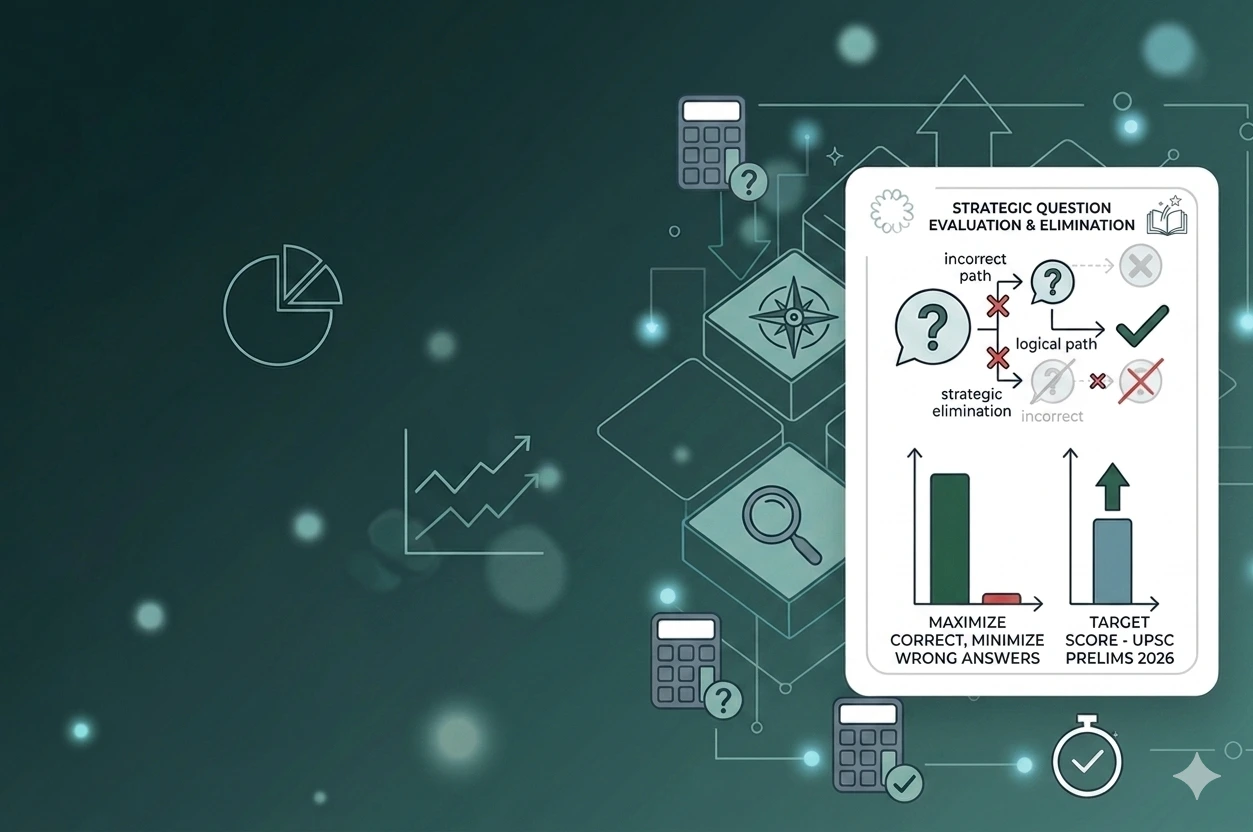
Negative marking in UPSC Prelims deducts 0.66 marks for every wrong answer in GS Paper 1 and 0.83 marks for every wrong answer in CSAT. Knowing the rule is not the problem. Managing it inside the exam hall when the clock is running is where most aspirants lose ground.
This guide gets into the specific decisions that cost real marks, with actual numbers so you can see exactly where your score is going.
What is Negative Marking in UPSC Prelims 2026 and Why Does It Matter More Than Ever?
The 2025 General category cutoff was 92.66 marks. Not 85. Not 88. 92.66.
The students who almost made it were probably sitting at 89 or 90, wondering where those 3 marks disappeared. In most of those cases the answer is 4 to 6 wrong answers in the last 20 minutes when panic sets in and judgment goes out the window.
That is not a knowledge problem. That is a decision problem.
In UPSC Prelims 2026, negative marking works like this. GS Paper 1 has 100 questions worth 2 marks each. Every wrong answer costs you 0.66 marks. CSAT has 80 questions worth 2.5 marks each and every wrong answer costs you 0.83 marks.
Those numbers feel small written like that. So let's put them into a real situation so you can actually feel what is happening to your score.
Say you attempt 82 questions. 68 correct, 14 wrong.
Correct answers: 68 x 2 = 136 marks Wrong answers: 14 x 0.66 = 9.24 marks gone Final score: 126.76
Now imagine you had left 6 of those 14 wrong answers blank. Just skipped them.
Correct answers: 68 x 2 = 136 marks Wrong answers: 8 x 0.66 = 5.28 marks gone Final score: 130.72
Same knowledge. Same preparation. 4 extra marks just from one better decision in the exam hall.
At a cutoff of 92.66 that gap feels comfortable. But the cutoff is rising every year. And in a year where the paper is slightly easier and everyone scores higher, that 4 marks is the difference between Mains and going home.
Use our UPSC Negative Marking Calculator to run your own numbers right now before reading further. Plug in your last mock test score and see exactly how much negative marking cost you.
Why Do UPSC Aspirants Keep Losing Marks to Negative Marking Even After Knowing the Rules?
This is the question nobody asks. Everyone explains what negative marking is. Nobody explains why smart, well-prepared students keep falling into the same trap year after year.
Here is what actually happens inside the exam hall.
You have been preparing for 14 months. You sit down, the paper starts, and the first 30 questions feel manageable. You are in a rhythm. Then you hit a question on some obscure environmental treaty and something in your brain says "I think I've seen this somewhere." That feeling is not knowledge. That is familiarity. And familiarity in a high-pressure exam hall feels exactly like confidence.
You mark the answer.
Then it happens again at question 51. And again at question 73. By the time you are in the last 15 minutes you are running on adrenaline and your threshold for what counts as "I know this" has quietly dropped from 85% sure to 55% sure without you realizing it.
This is not a willpower problem. This is how the human brain works under time pressure. The UPSC paper is specifically designed to exploit this. The options are written to sound familiar even when you do not know the answer.
The students who consistently beat negative marking are not smarter. They just have a system that does not rely on their in-the-moment confidence levels.
How Many Questions Should You Attempt in UPSC Prelims 2026 to Avoid Negative Marking?
There is no perfect number. Anyone who gives you a fixed number like "attempt exactly 75 questions" is guessing.
What actually matters is your personal accuracy rate on uncertain questions.
Here is how to find yours. Go back to your last three mock tests. Count how many questions you attempted where you were not fully sure of the answer. Then count how many of those you got right. Divide right answers by total uncertain attempts. That percentage is your uncertainty accuracy rate.
If your uncertainty accuracy rate is above 50%, educated guessing is working for you. Keep doing it but track it every single mock.
If your uncertainty accuracy rate is below 40%, every uncertain attempt you make is statistically destroying your score. You need to stop attempting those questions entirely until your preparation improves in those areas.
Most aspirants have never done this calculation. They just have a vague sense of "I'm an okay guesser." That vague sense is costing them marks.
The sweet spot for most aspirants preparing for UPSC Prelims 2026 is attempting between 75 and 85 questions in GS Paper 1, but only if at least 65 of those are attempts where you are genuinely confident. The remaining 10 to 20 should only be questions where you can eliminate at least two options with real reasoning, not just a feeling.
What is the Right Strategy to Avoid Negative Marking in UPSC Prelims GS Paper 1?
Stop reading the question and immediately starting to evaluate options. That is the single habit change that separates disciplined aspirants from reactive ones.
Here is the actual approach.
Read the question fully. Before you look at the options, form your own answer in your head. Even a rough one. Then look at the options. If your answer matches one of them with confidence, mark it and move on. If your answer does not clearly match, or if two options both seem possible, put a small mark next to that question number and skip it for now.
Do your entire paper this way in the first round. You will get through 70 to 75 questions you are confident about. Your score is already building on solid ground.
In your second round, go back to the skipped questions. Now you are not under the pressure of moving forward. You have time. Look at each option and ask yourself one specific question: can I give a reason why this option is wrong, based on something I actually studied, not just a feeling? If you can eliminate two options with real reasoning, you have a 50-50 chance. At 50-50 your expected value from attempting is positive because 1 right answer gives you 2 marks and 1 wrong costs only 0.66. Attempt those.
If you cannot eliminate anything with actual reasoning, leave it blank. Do not let the blank bubble bother you psychologically. A blank question scores zero. A wrong answer in UPSC Prelims scores minus 0.66. Those are not the same thing.
How Does Negative Marking in UPSC Prelims CSAT 2026 Work Differently and Why Do Students Underestimate It?
Most aspirants spend 90% of their exam strategy thinking about GS Paper 1 and treat CSAT as an afterthought because it is qualifying. That is a serious mistake.
CSAT negative marking is actually more punishing per wrong answer than GS. Each wrong answer in CSAT costs you 0.83 marks compared to 0.66 in GS. And because CSAT questions on reading comprehension and logical reasoning feel more "solvable," aspirants tend to attempt more of them with false confidence.
The specific CSAT trap is reading comprehension. You read a long passage, you feel like you understood it, you look at the question and two options both seem supported by the passage. One of them is a slight overreach or inference that the passage does not directly support. You pick it. You lose 0.83 marks.
You can qualify CSAT comfortably by attempting 40 to 45 questions accurately. Attempting 70 questions with shaky accuracy and losing 20 to negative marking is how people fail a qualifying paper they should have passed easily.
What Are the Most Common Negative Marking Mistakes in UPSC Prelims That Even Serious Aspirants Make?
The "I've seen this in a PYQ" trap
Seeing a similar question in a previous year paper does not mean this year's question has the same answer. UPSC frequently modifies fact-based questions slightly. The ecosystem of a wetland listed in one year's question is not the same wetland in this year's question. Read the full question. Do not pattern-match and auto-fill.
The OMR rush at the end
Some aspirants mark answers on the question paper first and transfer to OMR at the end. If you do this and you run out of time, you are now frantically filling bubbles without re-reading questions. One wrong row and you have shifted every subsequent answer down by one. This has happened to aspirants who knew the answers and still failed because of a 3-minute OMR disaster. Mark directly on the OMR as you go. It is slower but it is safe.
Changing answers in the last 10 minutes
Your first instinct on most factual questions is more reliable than your second-guess made under time pressure. Research on MCQ test-taking consistently shows that changed answers are wrong more often than original answers in timed conditions. Unless you have found a specific, concrete reason why your first answer was wrong, do not change it in the final minutes.
The "I'll attempt it and see" mindset on multi-statement questions
Questions with statements like "which of the following is/are correct" are the most dangerous in UPSC Prelims for negative marking. You might know that Statement 1 is correct. But if you are not sure about Statement 2 or 3, and the option choices require you to commit to a combination, you are essentially guessing the full answer. These questions have a much lower success rate for aspirants attempting without complete knowledge. Leave them for round 2 and only come back if you can verify each statement independently.
How to Use Mock Tests to Actually Fix Your Negative Marking Behaviour
After every mock test most aspirants check their total score, feel good or bad about it, and move on. The more useful thing to do takes about ten minutes and most people never do it.
Run three numbers. What you actually scored. What you would have scored if you had left your five most uncertain wrong answers blank. What you would have scored if you had left every wrong answer blank.
The gap between the first number and the third is how much negative marking cost you that day. Write it down after every mock. If it is consistently above 8 to 10 marks the problem is not your preparation, it is the decisions you are making inside the exam when you are tired and the clock is moving. Reading more will not fix that. Only changing how you behave in those moments will.
If the gap is below 4 marks you are already making sound decisions. The work then is not cutting back attempts but building enough confident ones to push your score higher.
Test series reports will not show you this number because they only track what you got right. This tracks what you chose to risk and whether that risk was actually worth taking.
What is the Safe Score in UPSC Prelims to Clear the Cutoff Without Relying on Negative Marking Luck?
Based on the last three years of cutoff data, the General category cutoff has moved between 87.98 in 2024 and 92.66 in 2025. For 2026 the safe target is 100 to 105 marks in GS Paper 1, accounting for paper difficulty variation.
To reach 100 marks without relying on risky attempts you need roughly 58 to 60 correct answers out of 100 questions if you keep wrong answers below 8. That means you do not need to know everything. You need to know 60 things with genuine confidence and exercise restraint on everything else.
That is the mental reframe that changes how you prepare. Instead of trying to cover every topic so you can attempt 90 questions, focus on mastering your strongest 6 to 7 subject areas deeply enough that your confident attempt count naturally reaches 60 to 65 questions. Then let the calculator protect the rest.
Calculate your safe score target right now using the UPSC prelims Marks Calculator before your next mock. Enter your target score, work backwards to find how many correct answers you need, and build your next month of preparation around reaching that specific number, not a vague "score higher" goal.
Calculate Your Exam Score
Use our free negative marking calculator to estimate your score and plan your attempt strategy.
Try the Calculator →